When You Wake Up Suddenly Gasping for Breath While Sleeping: How to Calm Nocturnal Panic Disorder

 🧾 Answer First | Key Conclusion
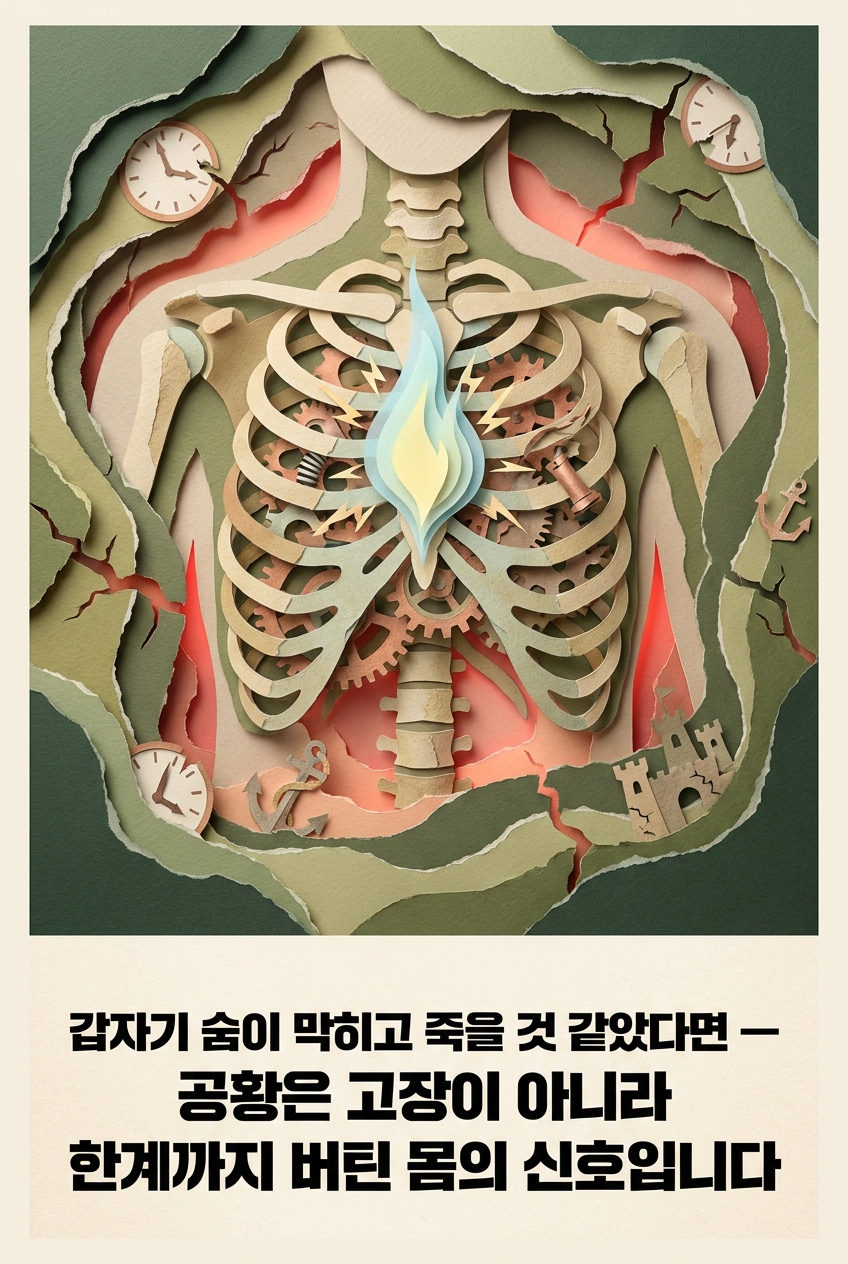
Many people complain of fear, saying "I suddenly feel chest tightness and my breath is cut off while sleeping, as if I'm about to die right now."
Are you staying awake all night with open eyes after your breath suddenly stops in the early morning, listening to your heart pounding?
Hello.
I am Dr. Choi Jang-hyuk, director of Dongjedad Korean Medicine Clinic.
This is not simply a nightmare or a respiratory problem.
There is a very high possibility that this is a 'nocturnal panic attack.'
If your heart is racing and you feel like you're suffocating, first take comfort.
It will absolutely not harm your life.
You can calm it down immediately with the correct coping method.
From now on, follow only these three methods I'm about to teach you.
 ✅ Action | Immediate Action
If you wake up gasping for breath, do not try to hold your breath or endure it while lying down.
Execute the following three things immediately.
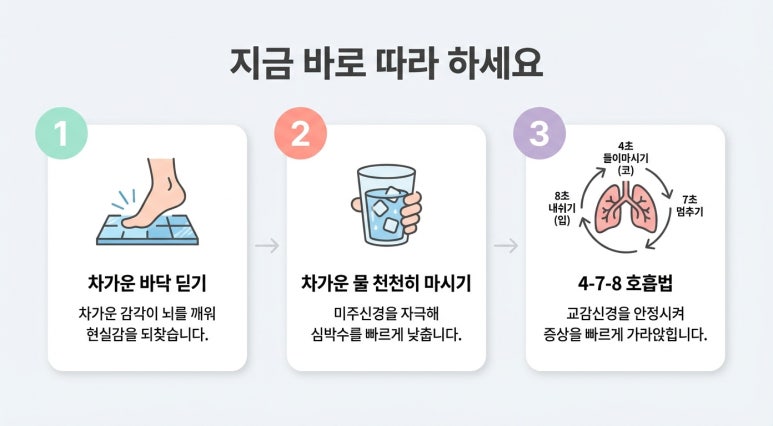
1️⃣ Get Out of Bed and Stand Firmly on Cold Flooring
If you continue lying in bed, your brain will mistake itself as being trapped, and anxiety will grow even more.
Get up immediately and stand firmly on the cold floor with both feet.
The cold sensation touching your soles awakens your brain and quickly restores your sense of reality.
2️⃣ Drink a Small Sip of Cold Water Slowly
Prepare a glass of cold water and swallow a single sip very slowly.
As the cold water stimulates your esophagus on its way down, a nerve that stabilizes our body (the vagus nerve) awakens.
This immediately suppresses the abnormally elevated sympathetic nervous system.
It has the effect of quickly lowering your heart rate that was about to burst.
3️⃣ Stabilize Your Nerves with the 4-7-8 Breathing Technique
This is the most critical emergency coping method.
Breathe in deeply through your nose for 4 seconds, hold your breath for 7 seconds, then exhale slowly through your mouth for 8 seconds.
Simply repeating this breathing technique properly will stabilize your sympathetic nervous system.
70% of symptoms subside within 3 minutes.
 🚨 Warning | Warning Signs You Must Check
At this time, when your mind becomes impatient, there are things you must absolutely avoid doing.
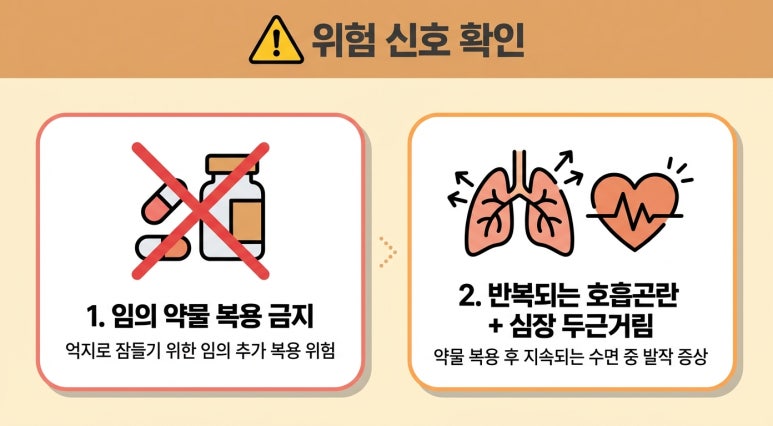
✔ Do Not Take Additional Medication Arbitrarily to Force Sleep
Taking medication arbitrarily to force sleep while breathing is difficult is dangerous.
In particular, self-medication without consulting a doctor should be avoided due to concerns about sleep-inducing panic attacks.
It could weaken your breathing during sleep and worsen symptoms.
✔ Repeated Nocturnal Breathing Difficulties After Medication
If similar panic symptoms during sleep repeat when taking panic disorder medication, careful attention is needed.
Certain antidepressants can cause nocturnal breathing difficulties or sedative side effects, which can destabilize sleep structure.
Heart racing or dull symptoms may continue until the next morning.
In this case, do not stop medication arbitrarily and consult with your physician.
 🧠 The Why | Understanding the Cause
Why do you suddenly have difficulty breathing at night when you should be resting most comfortably?
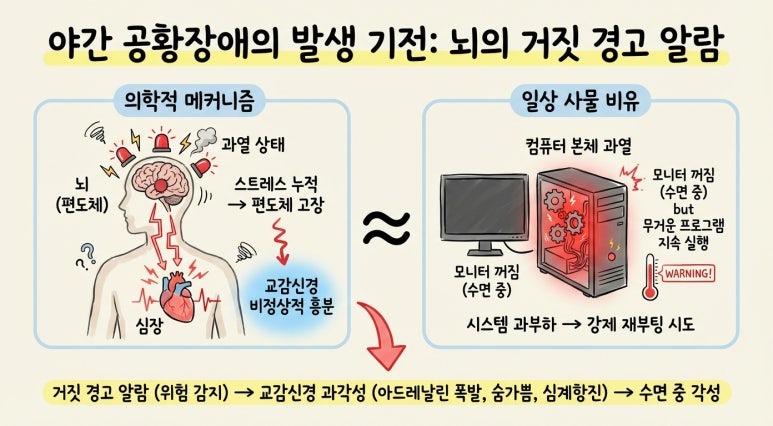
The fundamental reason is the excessive work stress and nerve fatigue that have accumulated layer upon layer throughout the day.
Our brain maintains an excessively tense state without rest even while the body sleeps.
It's like a computer monitor screen being turned off but a heavy program continuing to run inside the CPU.
It continues running and becomes severely overheated.
When stress accumulates to its limit, the balance of the autonomic nervous system, which acts as a brake for our body, completely collapses.
As a result, the accelerator pedal of the sympathetic nervous system becomes abnormally excited even during sleep.
In reality, your safe bedroom has no danger whatsoever.
However, the brain region that detects anxiety (the amygdala) malfunctions and triggers a 'false warning alarm' that life is in critical danger.
As a result, the brain secretes large amounts of adrenaline to escape the perceived danger.
You suddenly have difficulty breathing during sleep, your chest pounds, and you wake up.
📊 Proof | Cases and Evidence
A 30-something office worker patient I treated in my clinic also suffered from similar symptoms.
Every night, his breath was suddenly cut off, and he visited the emergency room three times.
However, all heart and lung test results were normal.
Based on Korean medicine diagnosis, I focused on stabilizing this patient's overheated sympathetic nervous system.
I also provided treatment to restore the suppressed parasympathetic nervous system.
I consistently performed acupuncture treatment and customized herbal medicine prescriptions for two weeks.
The patient's frequency of waking during sleep decreased noticeably.
Finally, he was able to sleep soundly without waking in the middle of the night.
In fact, according to Korean medicine clinical practice guidelines, the effectiveness of Korean medical treatment that regulates the autonomic nervous system has been proven[3].
It has the effect of significantly reducing physical tension in anxiety disorder patients.
Among the patients I have seen in my clinic, 80% experienced clear improvement when receiving proper treatment.
These are positive changes that appeared within the first month.
In my experience, nocturnal panic disorder will clearly improve if you reduce the state of hyperarousal in the brain and body.
 🔚 Closing | Summary and Encouragement
The symptom of waking up gasping for breath while sleeping is an urgent rest signal.
It is a signal your body is sending, pleading for you to let it rest.
No longer tremble alone in the face of mysterious fear that visits you every night.
Try the breathing technique and behavioral guidelines I've introduced today starting tonight.
If symptoms persist and your daily life falls apart, please feel free to ask for my help at any time.
I will do my best to help you regain comfortable nights and energetic mornings.
✍️ Reviewed by Dr. Choi Jang-hyuk, Director of Dongjedad Korean Medicine Clinic
❓ FAQ
Q. What are the initial symptoms of nocturnal panic disorder?
Sudden breathing difficulties and cold sweats during sleep are representative symptoms.
Chest tightness and heart palpitations also appear together.
You did not have a scary nightmare, and the room was not hot.
If your heart suddenly feels like it's about to burst and your breath is cut off, you should suspect a nocturnal panic attack.
Q. Is it possible to manage nocturnal panic disorder without medication?
Yes, it can be managed with proper lifestyle routines before bedtime.
Symptom relief is sufficiently possible through breathing technique training.
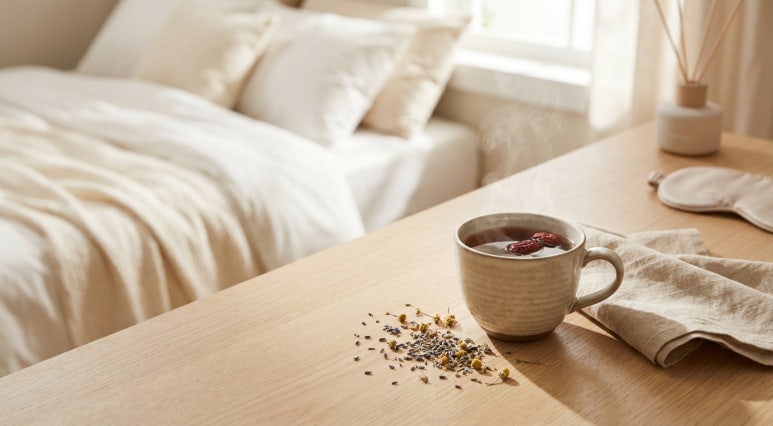
It is good to drink warm chamomile or jujube tea one hour before bedtime.
Reduce the habit of watching smartphones while lying in bed.
The most important thing is to give your overheated brain sufficient rest.
Q. Is it possible to treat panic disorder at a Korean medicine clinic?
Yes, acupuncture treatment and herbal medicine prescriptions at Korean medicine clinics are very effective.
They help restore the collapsed balance of the autonomic nervous system.
It gently calms the overheated sympathetic nervous system and activates the parasympathetic nervous system.
It corrects the brain's faulty alarm system and fundamentally improves sleep quality.
📚 References
Western Medicine
[1] NICE (2023). "Generalised anxiety disorder and panic disorder"
[2] BMJ Best Practice (2022). "Panic disorder - Management"
Korean Medicine
[3] Korean Medicine Association CPG (2021). "Korean Medicine Clinical Practice Guidelines for Panic Disorder"
[4] NIKOM (2020). "Korean Medicine Treatment of Anxiety Disorders"