Why Gastroesophageal Reflux Disease Can Be Resolved with Diet Herbal Medicine — Different Appearances of the Same Cause

Answer First | Core Conclusion
Many people with gastroesophageal reflux disease improve with diet herbal medicine.
This is not a coincidence.
I am Dr. Choi Jang-hyuk, a Korean medicine practitioner.
One of the most frequent scenes I encounter while providing treatment at Dongjjedang Korean Medicine Clinic is this:
When I ask patients who come for weight loss purposes during their first consultation, almost half say "Actually, my stomach isn't doing well."
Many complain of chest tightness, experience acid reflux in the early morning, and have been taking PPI (proton pump inhibitors) for over a year.
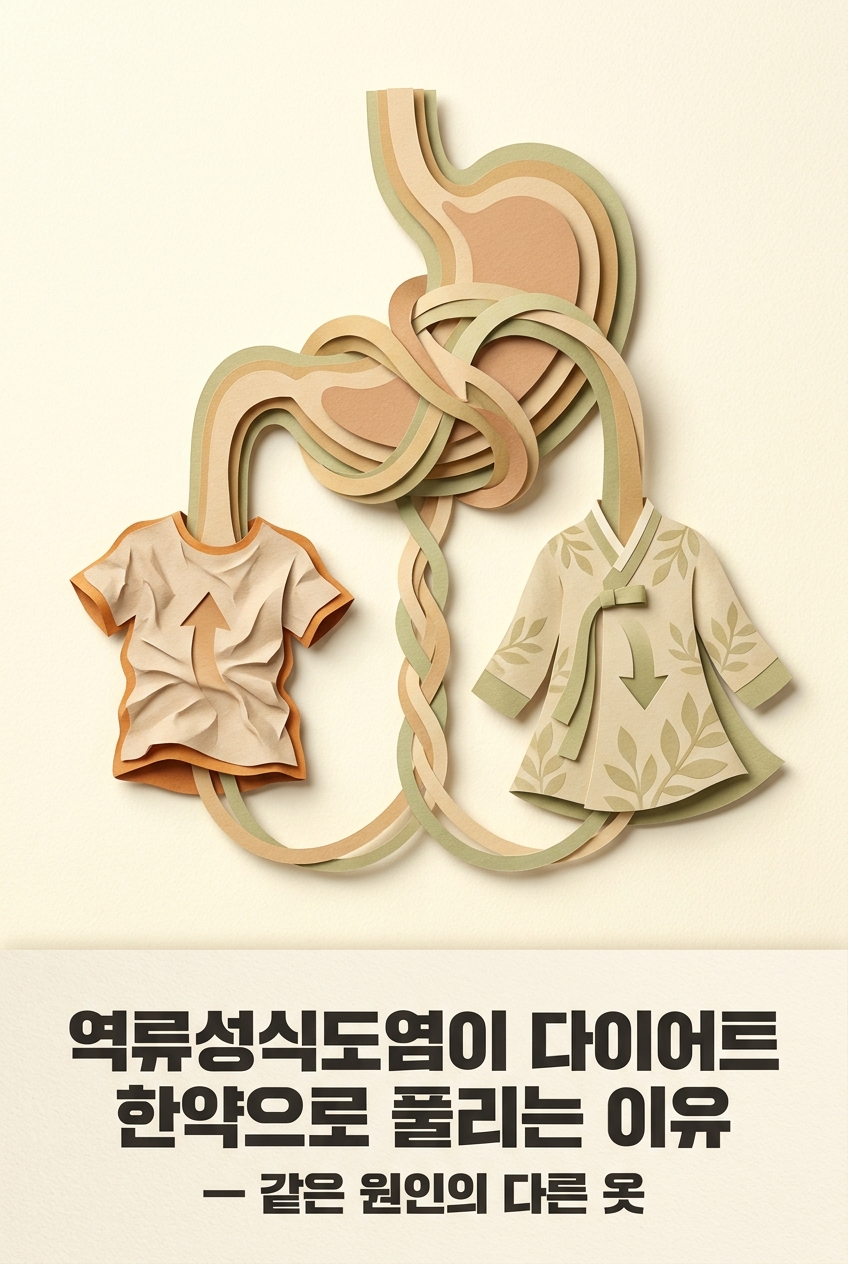
Diet and GERD may appear to be different diseases, but they are two different landscapes arising from the same place: excess waste accumulation in the stomach.
On one side, it manifests as weight that won't decrease; on the other side, it manifests as stomach contents flowing backward.
That is why when you start a diet treatment, the reflux symptoms improve together.
The same applies to patients whose primary concern is not weight loss.
Action | Immediate Implementation
I always provide these three initial guidelines to first-time patients in my consultation room:
1️⃣ Eliminate late-night snacking and late dinners
You should finish eating 3 hours before bedtime.
When you lie down after eating late-night food, the food is pushed backward from the stomach into the esophagus.
This is because when you lie down with food remaining in the stomach, the pressure inside the stomach directs toward the esophagus.
Greasy and spicy foods like ramen, tteokbokki, and fried chicken remain in the stomach for 4-6 hours.
2️⃣ Light walking for 30 minutes after meals, without lying down
Do not lean deeply into a sofa or lie down immediately after eating.
A 10-minute walk is sufficient.
You are giving your gastrointestinal system time to move food downward.
3️⃣ Target weight loss of 5-10%
This is the most powerful single lifestyle intervention.
The American College of Gastroenterology (ACG) 2022 clinical guidelines also recommend weight loss as the primary lifestyle modification for improving GERD symptoms.
If you weigh 70kg, aim for 3.5-7kg; if you weigh 80kg, aim for 4-8kg.
Many patients experience a reduction in reflux frequency to less than half with just this amount of weight loss.
If you see no changes even after trying these three methods for more than 2 weeks, it would be efficient to examine what kind of excess waste is accumulating in your stomach.
Warning | Warning Signs You Must Check
If you experience the following three warning signs, an endoscopy should be performed before herbal medicine or diet:
✔ Black stools or vomiting blood
There may be gastrointestinal bleeding. You must go to the emergency room or gastroenterology immediately.
✔ Unintended weight loss within 6 months + difficulty swallowing
Esophageal stricture or tumor differentiation takes priority.
✔ First occurrence of reflux after age 50 + anemia
You should get an endoscopy first.
In these cases, I also recommend endoscopy immediately in the consultation room.
Herbal medicine is the next step.
The Why | Root Cause Analysis
I view the backward flow of stomach contents from two perspectives:
Explanation | Western Medicine Perspective
Patients with obesity have visceral fat pushing up the diaphragm.
The valve at the top of the stomach (lower esophageal sphincter) that should remain closed frequently opens loosely.
Chronic low-grade inflammation follows as well.
The same thing happens even in people without significant weight gain.
If food and excess body fluids accumulate in the stomach, the pressure still directs upward.
Explanation | Korean Medicine Perspective
Food stagnation (食積), phlegm-fluid accumulation (痰飮), and water toxicity (水毒).
Food that hasn't moved down properly and accumulates in the stomach is food stagnation; sticky mucous waste that has hardened is phlegm-fluid accumulation; and excess body fluids stagnating between tissues is water toxicity.
All three represent a state where excess waste accumulates in the stomach area.
When excess accumulates in the stomach area, the middle burner (中焦 — the area around the stomach) becomes blocked.
When qi encounters blockage in that area, it loses its proper pathway and flows backward.
This is the exact location described in the Dongui Bogam as belching, heartburn, and acid reflux (噫嗳吞酸).
That is why adding more stomach medicine doesn't stop the symptoms.
PPI only suppresses acid but does not remove the excess waste inside the stomach.
If the excess remains while acid is suppressed, the symptoms return immediately when the medication is discontinued.
What we call a diet treatment actually works by removing the excess.
Excess body fluids (diuretic phase), excess fat (first and second weight loss phase), excess food stagnation (detoxification pills).
When the excess in the stomach area is removed, the accompanying backward flow of the stomach resolves as well.
I want to emphasize one important point here:
When I examine patients who had stopped late-night eating, taken PPI for a year, and still experienced repeated reflux, it was not because their willpower was weak.
The situation they found themselves in — a job with frequent evening gatherings as part of daily life, a pattern where tension only releases late at night when returning home, a table where foods unsuitable for their constitution became everyday meals — that situation produced these symptoms.
If the situation remains unchanged, willpower cannot hold out long.
Proof | Case Studies and Evidence
A man in his late 40s came for diet purposes.
He had gained 8kg over 5 years and had been taking PPI for over a year.
During my first consultation, I always ask about the situation first.
Rather than asking "when it started," I first ask "what was happening at that time."
He said there was a department transfer 5 years ago, and after that, evening gatherings 2-3 times a week became routine.
On days without gatherings, he had developed a pattern of ending the day with late ramen or snacks in the evening.
The PPI prescription came around the same time.
He started a 12-week program with constitution-based herbal medicine.
Diuretic phase (weeks 2-3): This is when excess body fluids are removed.
During this phase, his early morning acid reflux disappeared.
Only 1.5kg of weight had been lost, but he was amazed that the acid reflux that used to come when lying down was gone.
First weight loss phase (weeks 4-6): This is when clothes start to fit loosely. He reduced his PPI to every other day on his own judgment and, finding no problems, discontinued it.
Plateau phase (weeks 1-3): This appears to be stalled, but the body is in a recovery stage.
Body fat decreases while muscle increases.
He became anxious once during this time, but the plateau phase is where the mind easily falters, so we saw each other frequently in the consultation room to get through it.
Second weight loss phase and conclusion (weeks 7-12): This is when real fat is lost. An additional 5kg was lost, and the actual size of the stomach decreased, naturally reducing meal portions.
At the end of 12 weeks: 8kg weight loss, PPI discontinued for two months, and the early morning acid reflux, chest tightness, and belching all disappeared.
He didn't change.
The excess waste in his stomach was removed.
Closing | Summary and Encouragement
This is the same conclusion from the "The 12-week diet is not the end" series.
12 weeks is time to empty the messy excess that was accumulating in the stomach area.
Once that space is emptied, you truly see how you have been eating and from what emotional flow that late-night eating originated.
It is also the first time you can see the clarity or cloudiness of your own mind (心地淸濁 — the texture of where your mind becomes clouded).
The real game begins after these 12 weeks.
A diet suited to your constitution, understanding the flow of your own mind.
Only someone who has emptied themselves once can walk the next path with their own feet.
Constitution diagnosis is an area that must be directly assessed in the consultation room.
Because the treatment approach for GERD, even when the condition appears the same, differs according to constitution.
If you want to resolve both diet and reflux together, take a look at the detoxification and diet program.
If reflux and digestive symptoms are more urgent, examine the digestive disease treatment, and then visit the clinic.
✍️ Dr. Choi Jang-hyuk, Director of Dongjjedang Korean Medicine Clinic, reviewed this
❓ FAQ
Q. My endoscopy is normal, but I have chest tightness. Will diet herbal medicine help?
A. Even though it doesn't show on endoscopy, there is excess waste in the stomach area. In Western medicine, this is called non-erosive reflux disease or functional dyspepsia; in Korean medicine, it is seen as fullness (痞滿) or belching (噫氣). The situation that needs to be emptied of excess is the same. The same treatment works regardless of whether weight loss is the goal.
Q. I want to stop taking PPI, but when I do, acid reflux immediately returns. Do I take herbal medicine and PPI together?
A. Many patients take them together initially. While herbal medicine removes excess, PPI suppresses acid. Once you pass the diuretic phase and reach the first weight loss phase, when early morning acid reflux begins to decrease, you are guided to slowly reduce it every other day or to once daily based on your own judgment. We don't stop it abruptly.
Q. Some people don't have much weight to lose but still have reflux. Isn't it just because of obesity?
A. That's correct. Even without obesity, if excess waste (food stagnation, phlegm-fluid, water toxicity) accumulates in the stomach area, the same thing happens. In lean people, reflux is mainly due to body fluids and food stagnation; in obese people, fat is also involved. The direction of treatment is the same: removing the excess.
Q. If weight loss isn't my goal, will I receive the same treatment?
A. The general direction of the treatment is similar, but for patients without strong weight loss intentions, we adjust the intensity of reduction. The work of removing excess is the same, but the degree of weight change varies depending on individual commitment and dietary cooperation.
References
Western Medicine
Katz PO, et al. ACG Clinical Guideline for the Diagnosis and Management of Gastroesophageal Reflux Disease. Am J Gastroenterol 2022;117(1):27-56.
Singh M, et al. Weight loss can lead to resolution of gastroesophageal reflux disease symptoms: a prospective intervention trial. Obesity (Silver Spring) 2013;21(2):284-290.
El-Serag HB. Time trends of gastroesophageal reflux disease: a systematic review. Clin Gastroenterol Hepatol 2007;5(1):17-26.
Korean Medicine
Korean Association of Oriental Medicine. 『Standard Clinical Practice Guideline for Gastroesophageal Reflux Disease in Korean Medicine』. NIKOM, 2021.
Huh Joon. 『Dongui Bogam』 Internal Landscape Section: Belching and Acid Reflux.
Korean Academy of Oriental Internal Medicine. Meta-analysis of clinical RCT on treatment effects of Banhasiakohuop-tang for GERD. 『Journal of the Korean Oriental Internal Medicine Society』 2023.