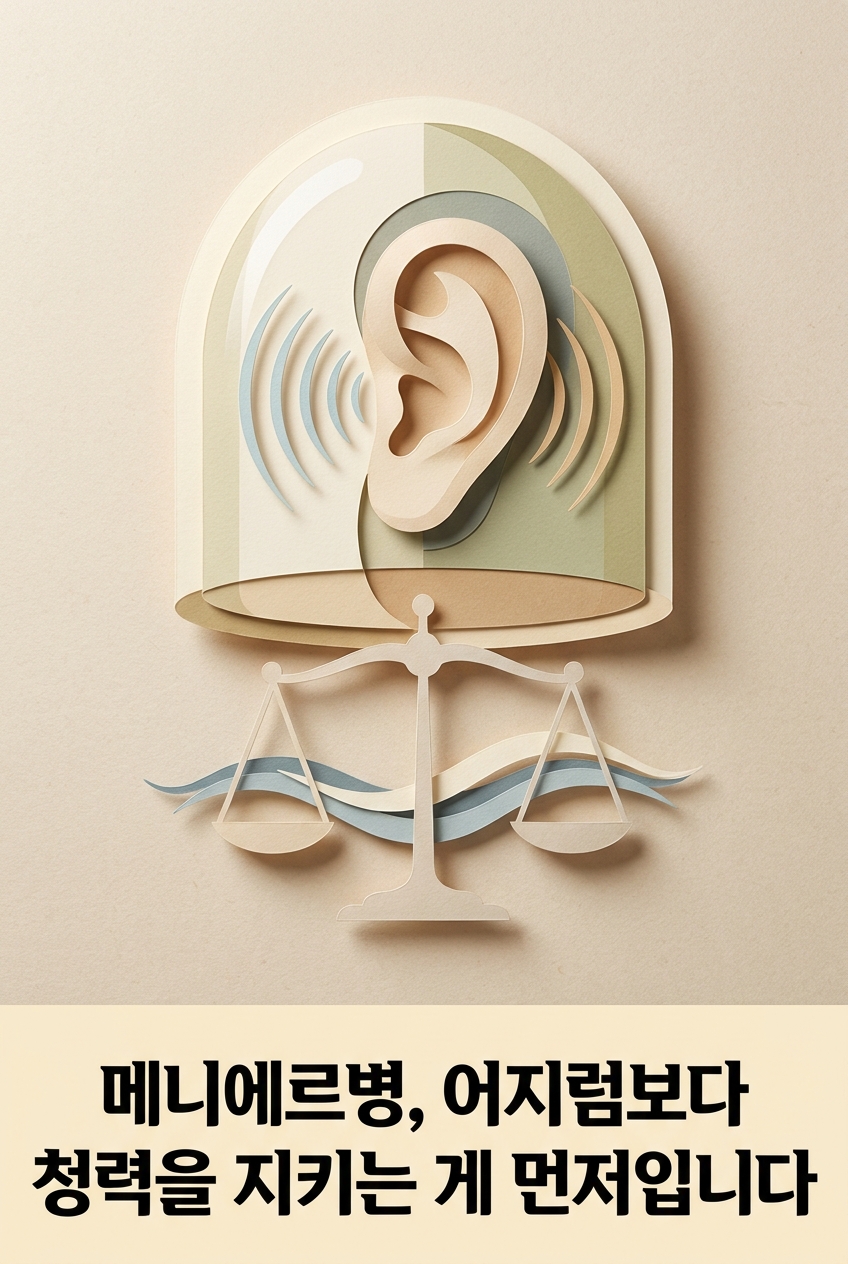
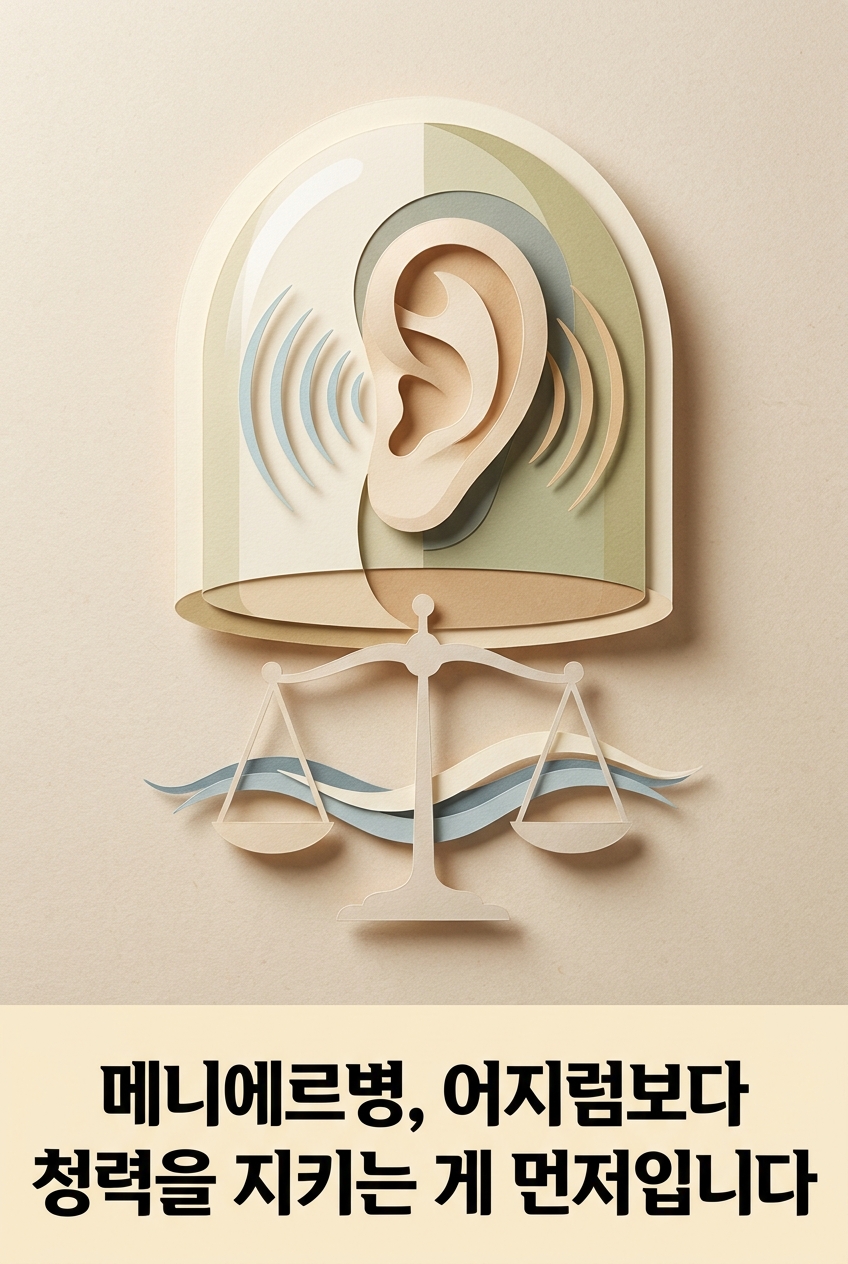
Ménière's Disease: Protecting Your Hearing Comes Before Treating Dizziness

 🧾 Answer First | Key Conclusion
If you experience spinning dizziness lasting from tens of minutes to several hours,
and one ear feels stuffy with a ringing sound and poor hearing — you may have Ménière's disease.
Even without a confirmed diagnosis, if dizziness, tinnitus, and ear fullness repeat together, it's the same issue.
I am Dr. Choi Jang-hyuk, director of Dongjae-dang Korean Medicine Clinic.
What's truly frightening about Ménière's disease is not the dizziness itself,
but the hearing loss that gradually erodes with each attack.
Once hearing is lost, it rarely returns.
That's why treatment has one goal: reducing recurrence to preserve hearing.
Draining fluid from the ear, managing body and mind — everything serves this single purpose. ✅ Action | Immediate Steps
1️⃣ If attacks are frequent, eat with less salt first
Salt, caffeine, and alcohol increase fluid in the ear.
While rigorous randomized trials are still lacking, this is the first step widely recommended in clinical practice.
Start by reducing broths and salty side dishes, and avoid coffee and alcohol.
2️⃣ Record changes in your hearing and tinnitus
Write down which ear, how much hearing loss, and what the tinnitus sounds like with each attack.
If hearing gradually worsens, don't delay — get tested by an ENT specialist.
Hearing must be protected while it still can be.
3️⃣ Also record "your emotional state that day" in your attack diary
Note how you slept the night before an attack and what caused tension.
If you see a pattern of accumulated tension, use 5-minute deep exhaling breaths before bed and maintain consistent sleep times to break that cycle. Rather than vaguely "reducing stress," find your personal attack trigger and address that specific point.
If attacks persist even after following these three steps, it's time to also address the body condition that causes recurrence.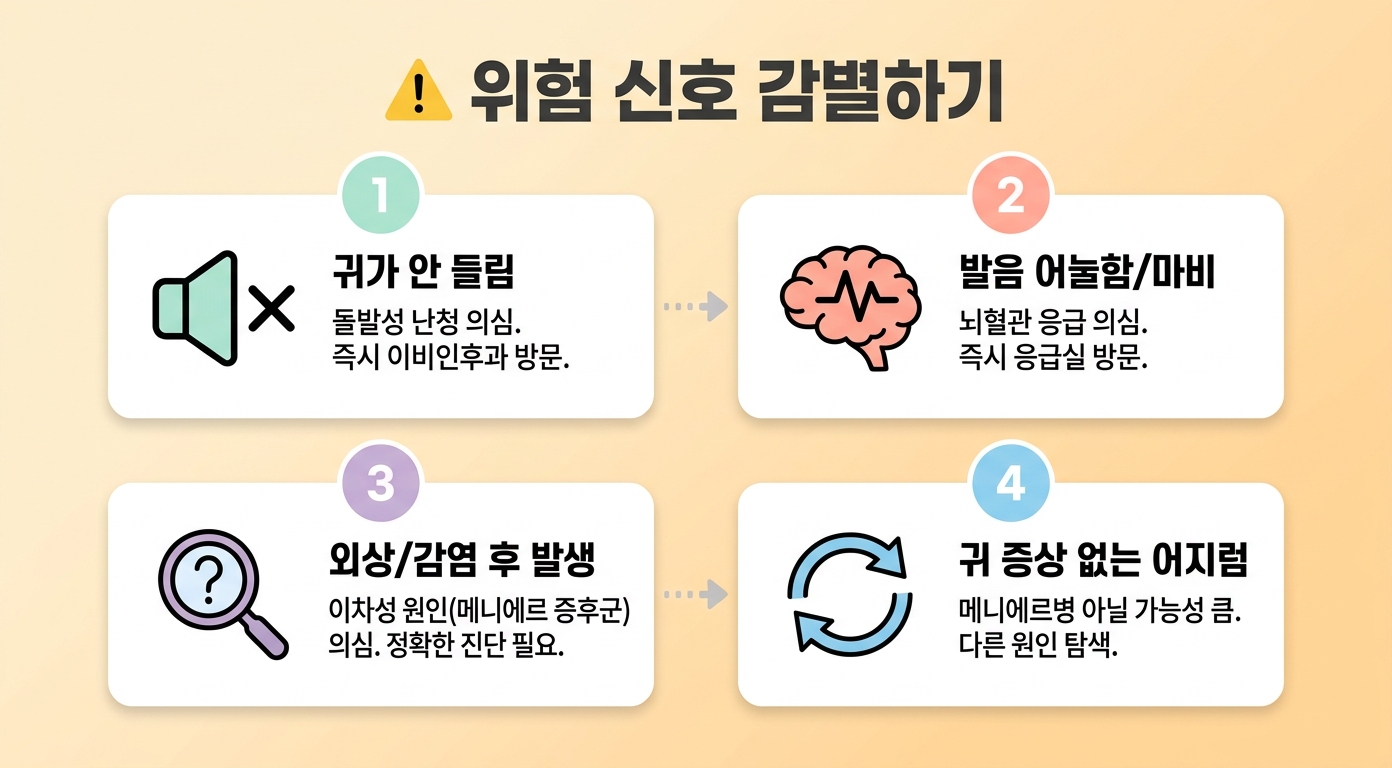 🚨 Warning | Critical Signs You Must Check
✔ One ear suddenly hears almost nothing
— This may be sudden sensorineural hearing loss. Treatment within days can save your hearing. Go to an ENT clinic immediately.
✔ Slurred speech, weakness in one arm or leg, double vision, or severe headache
— This may be a cerebrovascular emergency. Go to an emergency room at a large hospital immediately.
✔ Similar dizziness started after trauma, middle ear infection, or autoimmune disease
— This may be secondary (Ménière's syndrome) with another underlying cause.
The underlying condition must be treated first, so accurate diagnosis is essential even though symptoms are similar.
✔ Dizziness only in the head without ear symptoms
— This likely isn't Ménière's disease. Another cause must be identified.
Ménière's disease is characterized by dizziness, hearing loss, tinnitus, and ear fullness occurring together.
Since this disease affects hearing, diagnosis and monitoring must be done at a medical institution.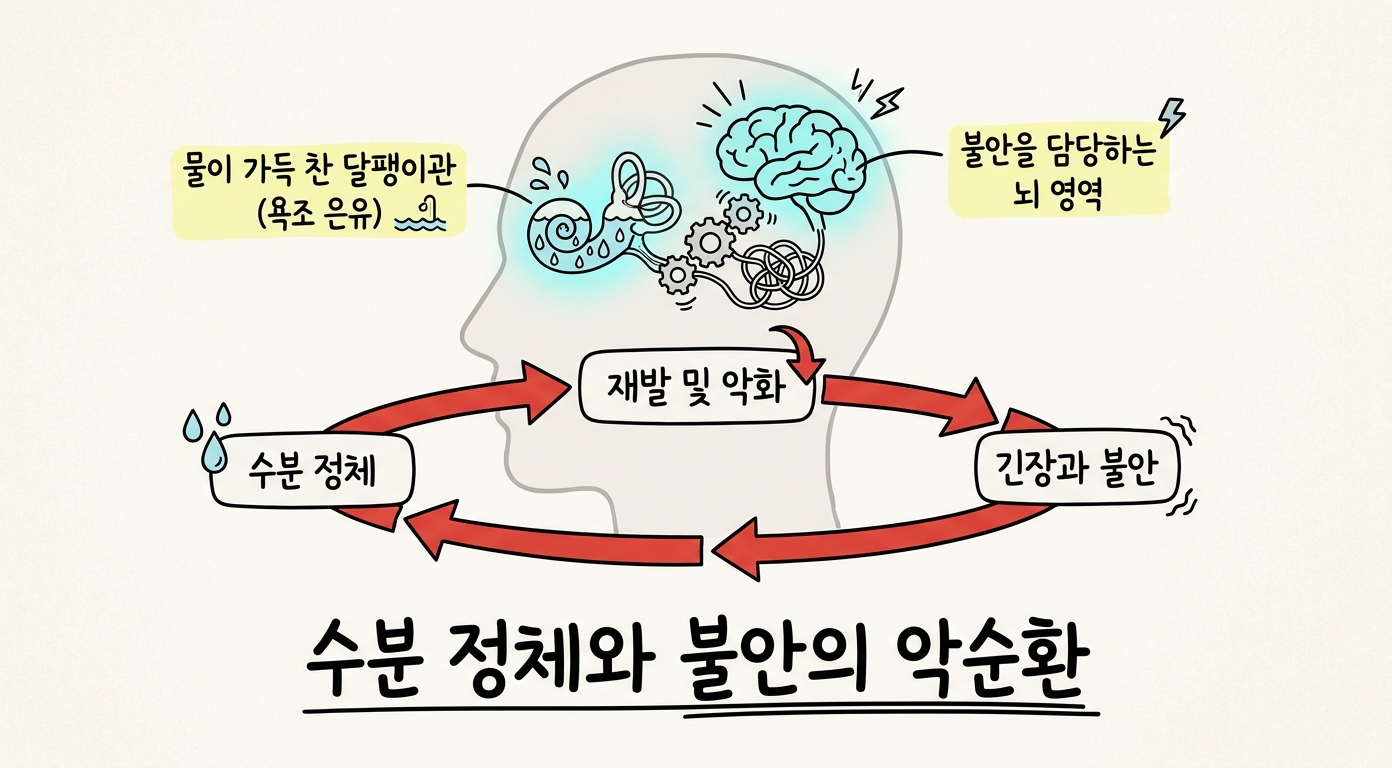 🧠 The Why | Understanding the Cause
Let me compare Ménière's disease to a bathtub.
The balance organ inside the ear normally contains a certain amount of fluid (endolymph).
But if drainage is blocked or too much fluid enters, the bathtub overflows.
When the excess fluid presses on the balance sensors, the world spins.
Low-salt diet, diuretics, and herbal formulas that drain fluid reduce this fluid to calm the dizziness.
The problem is that this cannot be the end.
Hearing loss doesn't disappear in a single attack.
Attacks come again and again, and with each recurrence, hearing gradually diminishes.
In other words, the real cause of hearing loss is not 'one episode of dizziness' but 'repeated recurrences.'
Then the path to protecting hearing is clear.
Rather than stopping one attack, prevent it from building up again.
The real question to ask is: 'Why does this person keep accumulating fluid?'
Even with the same Ménière's disease, the pattern of recurrence differs from person to person.
I view this pattern along two axes.
One axis is the body.
Korean medicine views stagnant, accumulated fluid as a manifestation of water retention and phlegm.
The old saying that "no dizziness without phlegm" touches on this.
We don't call the endolymph itself "phlegm,"
but if the body cannot mobilize and clear fluids in a timely manner, fluid accumulates again even after removal.
The other axis is anxiety.
And this axis is particularly heavy in Ménière's disease.
When balance organ function is heightened, anxiety increases together, while conversely, reports show those whose balance function is completely lost have less anxiety related to dizziness.
In other words, the balance circuitry of the ear and the brain circuits handling anxiety are bound together in one network, pulling each other up.
Cases with dizziness, panic, and shortness of breath together lie on the same network.
After a major attack, you worry, "Will I collapse again?"
That tension disrupts sleep and weakens the body, making it easier for fluid to accumulate again.
Lee Je-ma looked at disease from where the person stands.
For some, that network tightens where they bear responsibility alone; for others, where they're constantly rushed.
Without loosening that position together, simply draining fluid repeats the same cycle each time.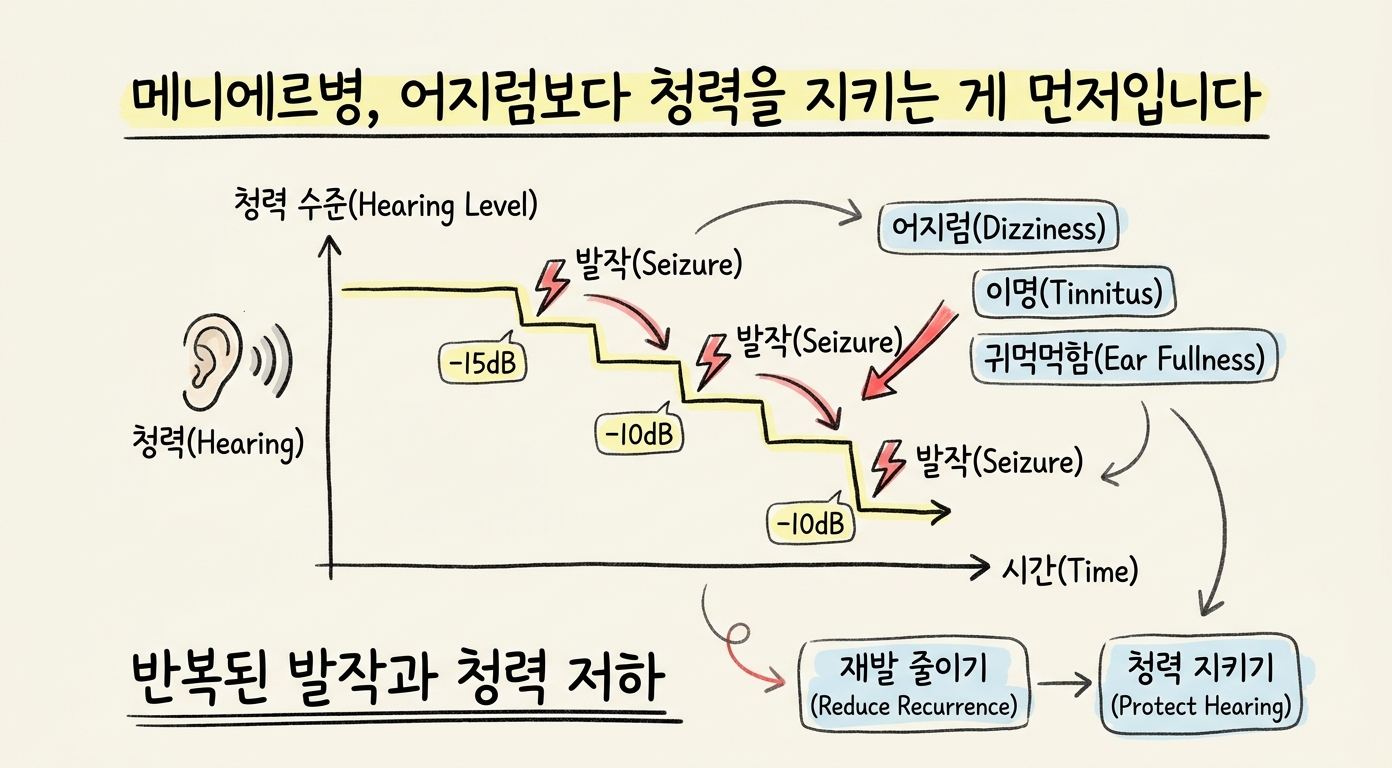 📊 Proof | Cases and Evidence
Let's start with what happens to hearing if Ménière's disease is left untreated.
On average after about 8 years, attacks decrease, but during that time, repeated attacks can permanently reduce hearing (Wu 2019, Can Fam Physician).
Hearing loss is the result of accumulated attacks.
The primarily recommended low-salt, caffeine, and alcohol restrictions lack randomized trials for verification, so effects cannot be confirmed or denied (Cochrane 2018).
The key is reducing recurrence.
In a study using herbal formulas to drain fluid in patients with confirmed Ménière's disease, dizziness attack frequency steadily decreased over 12 months (Koda 2025, Cureus).
In another Ménière's disease study, the 1-year complete control rate of dizziness in the herbal treatment group was higher than the standard medication-only group, and inner ear MRI confirmed actual reduction in fluid volume in the ear (Yamashita 2023, Auris Nasus Larynx).
In both studies, hearing itself didn't change significantly.
This is expected since already-lost hearing doesn't return,
and it demonstrates that reducing attacks to prevent further decline is the only way to preserve hearing.
Evidence that attacks and anxiety are intertwined in the same neural network supports this (Brandt & Dieterich 2020, Curr Opin Neurol).
I saw one 40-year-old patient who consistently had warning signs days before an attack — increased tinnitus and ear fullness in one ear.
I pinpointed when those warning signs began.
When deadlines and household chores coincided to shorten sleep, tinnitus would increase first, followed by a spinning attack days later.
While draining fluid to control acute dizziness, I also lifted sluggish fluid metabolism and addressed the tension point triggering those warnings.
As attack intervals lengthened, hearing test values stopped declining and stabilized.
Reducing recurrence was directly preserving hearing. 🔚 Closing | Summary and Encouragement
In Ménière's disease, dizziness is frightening, but what cannot be recovered once lost is hearing.
Since hearing erodes with each recurring attack, the only way to protect it is to reduce recurrence.
① Drain accumulated fluid in ways suited to your constitution to calm current attacks, and
② Resolve the network linking sluggish body that causes fluid buildup with the anxiety that pulls attacks,
preventing accumulation from happening again — two stages are therefore necessary.
Korean medicine is one axis for reducing recurrence and does not replace hearing monitoring and ENT treatment.
Both must proceed together.
Don't endure recurring dizziness and declining hearing alone.
If you wish to examine constitution and lifestyle together, please contact Dongjae-dang Korean Medicine Clinic's Head and Face Clinic.
✍️ Reviewed by Dr. Choi Jang-hyuk, Director of Dongjae-dang Korean Medicine Clinic
❓ FAQ
Q. How is Ménière's disease different from BPPV (benign paroxysmal positional vertigo)?
BPPV causes brief spinning when changing position lasting only seconds, then stops, with no ear symptoms.
Ménière's disease causes dizziness lasting from tens of minutes to several hours, accompanied by hearing loss, tinnitus, and ear fullness in one ear.
Since treatment approaches differ, accurate diagnosis is essential.
Q. Are Ménière's disease and Ménière's syndrome different?
Yes. When the cause is unknown, it's called Ménière's disease; when an underlying cause like trauma, infection, or autoimmune disease is identified, it's called Ménière's syndrome. Symptoms are similar, but syndrome requires treating the underlying cause first, so diagnosis distinguishing the two comes first.
Q. Is it completely better if dizziness just stops?
No. In Ménière's disease, what matters is hearing.
Since hearing erodes with each recurring attack (Wu 2019), even if dizziness temporarily stops, hearing can continue worsening if you don't reduce recurrence. Lowering attack frequency is directly protecting hearing.
Q. Can herbal medicine reduce Ménière's disease attacks?
Herbal treatment for draining fluid reduces dizziness attack frequency and lowers ear fluid volume on inner ear MRI (Koda 2025; Yamashita 2023).
However, hearing recovery is unlikely, and herbal medicine must accompany ENT hearing monitoring.
📚 References
[Western Medicine (WM)]
- Wu V, et al. (2019). Approach to Ménière disease management. Can Fam Physician. https://pubmed.ncbi.nlm.nih.gov/31300426/
- Hussain K, et al. (2018). Restriction of salt, caffeine and alcohol intake for Ménière's disease or syndrome. Cochrane Database Syst Rev. https://doi.org/10.1002/14651858.CD012173.pub2
- Brandt T, Dieterich M (2020). 'Excess anxiety' and 'less anxiety': both depend on vestibular function. Curr Opin Neurol. https://doi.org/10.1097/WCO.0000000000000771
[Korean Medicine and Kampo (KM·Kampo)]
- Koda Y (2025). Effectiveness of Goreisan in Ménière's Disease. Cureus. https://doi.org/10.7759/cureus.88643
- Yamashita A, et al. (2023). Changes in endolymphatic hydrops volume after medical treatments (incl. Saireito) for Ménière's disease using 3D MRI. Auris Nasus Larynx. https://doi.org/10.1016/j.anl.2023.02.002
- Phlegm-rheum pattern differentiation in dizziness and vertigo — "No vertigo without phlegm" classical theory (Danxi Xinfa)
Head & Face
Ménière's Disease: Protecting Your Hearing Comes Before Treating Dizziness
View Program