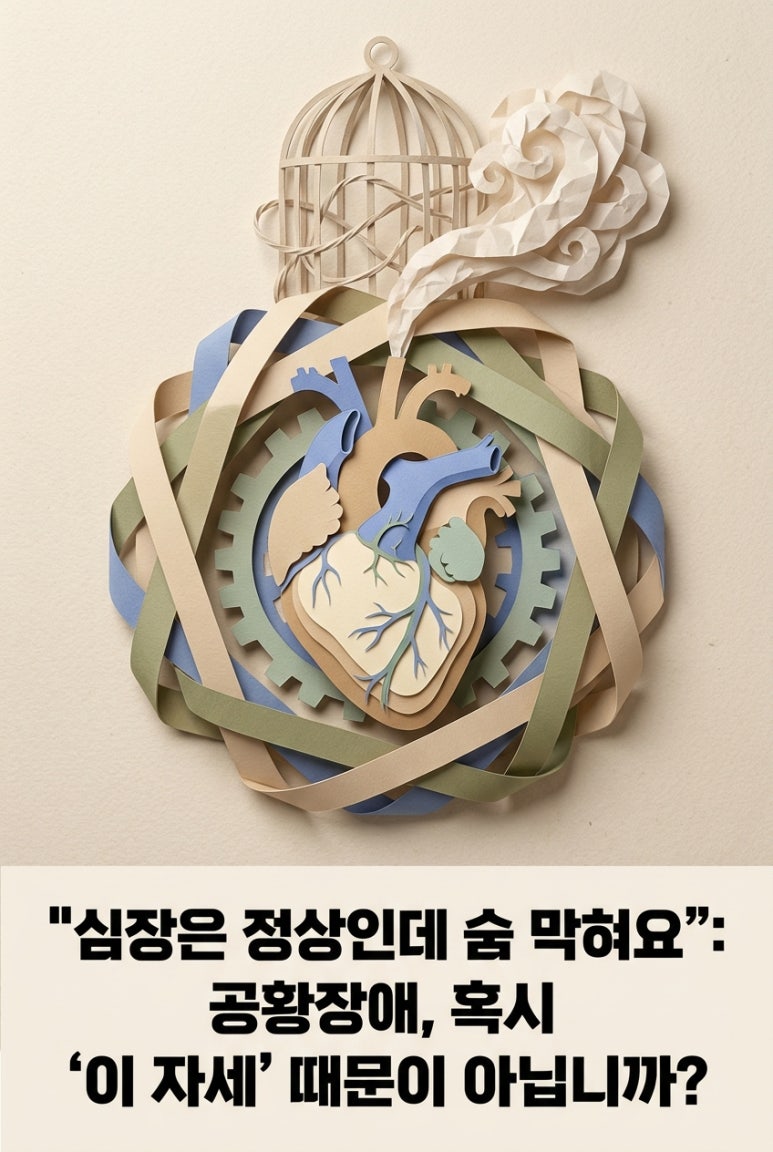
"My Heart is Normal, but I Can't Breathe": Panic Disorder—Could It Be Due to 'This Posture'?

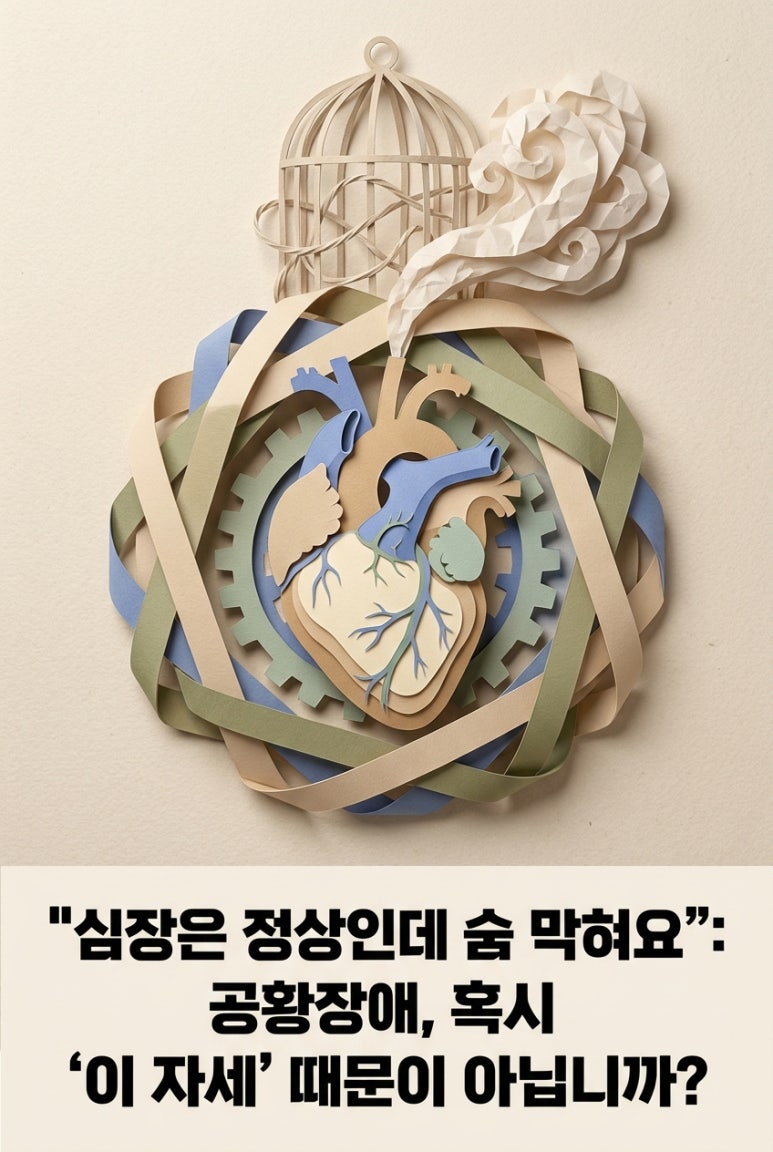 🧾 Answer First | Key Conclusion
Is your heart normal but you can't breathe?
The real culprit behind panic disorder may be 'posture'.
I am Director Choi Jang-hyuk of Dongjedang Korean Medicine Clinic.
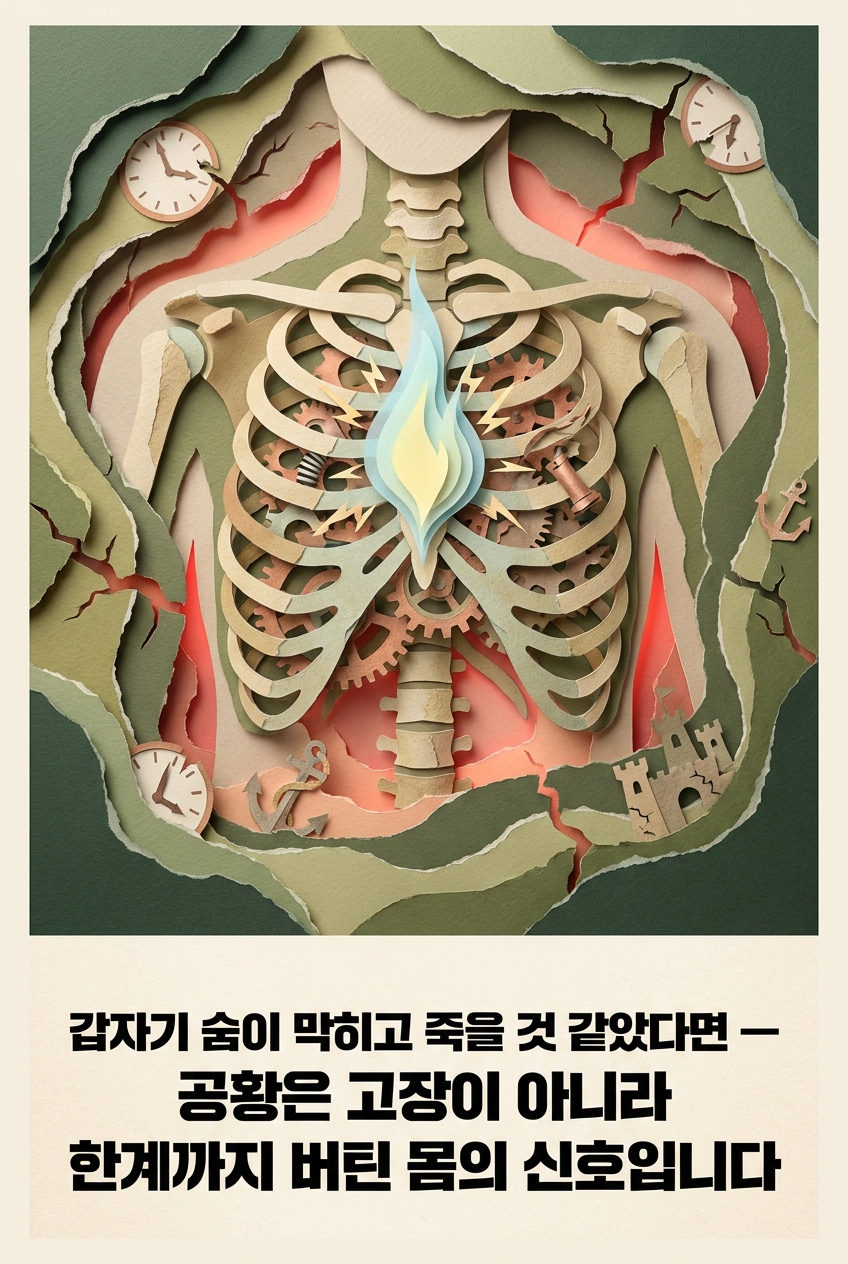
Your panic is a 'suffocation alarm' that your body is sending.
Like office worker A, you probably felt chest tightness and breathlessness, went to the emergency room, but were told your heart was normal and felt frustrated.
Breathing difficulty triggers anticipatory anxiety about dying, and that anxiety worsens the breathing difficulty.
We usually blame all of this on 'stress'.
But
In my clinic, I observe different signals your body is sending.
Namely: slouched posture, stiffened spine, and hardened breathing muscles (diaphragm).
Your panic disorder and anxiety symptoms may have originated not from your heart, but from structural tension in your 'breathing muscles'.
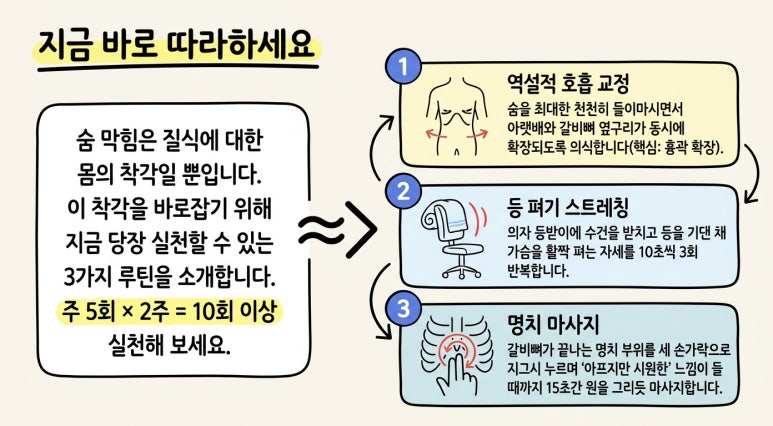 ✅ Action | Immediate Implementation
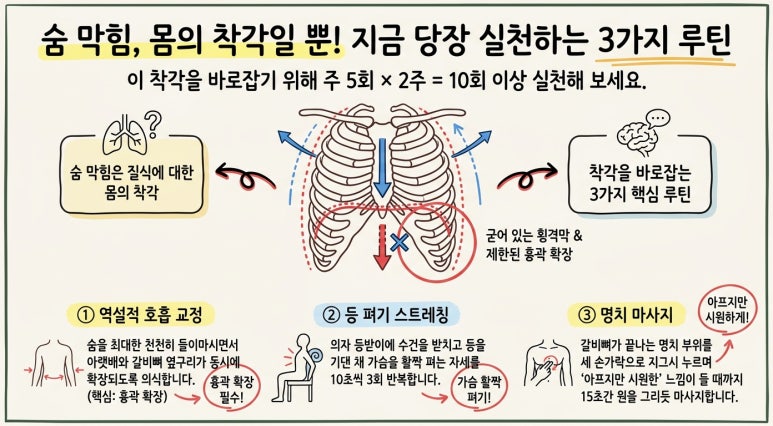
Breathing difficulty is merely your body's misinterpretation of suffocation.
To correct this misunderstanding, I introduce 3 routines you can implement right now.
Practice at least 10 times: 5 times per week × 2 weeks.
1️⃣ Paradoxical Breathing Correction
Inhale as slowly as possible while being conscious of simultaneously expanding your lower abdomen and the sides of your rib cage (Key point: thoracic expansion).
2️⃣ Back Straightening Stretch
Place a towel under the back of a chair, lean your back against it, and repeat 3 times, holding for 10 seconds each, while opening your chest fully.
3️⃣ Solar Plexus Massage
Press the solar plexus area (where the rib cage ends) with three fingers and massage in circles for 15 seconds until you feel a sensation that is "painful but refreshing".
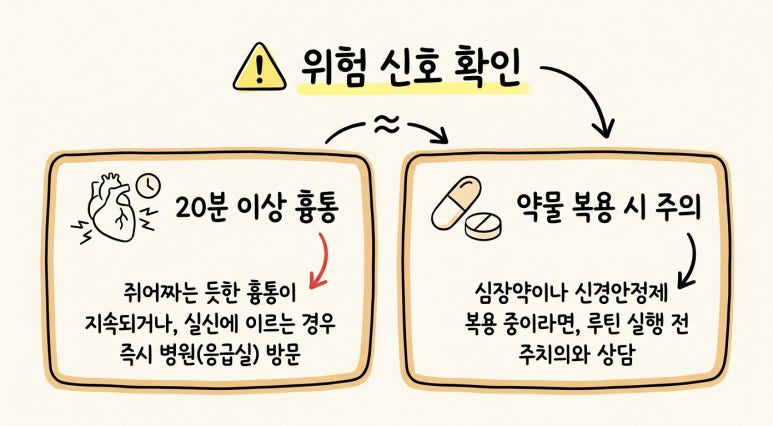 🚨 Warning | Warning Signs You Must Check
The following symptoms may go beyond posture problems or anxiety.
✔ Suspected Emergency Cardiac Condition
If squeezing chest pain persists for more than 20 minutes or if you actually lose consciousness, you must visit a hospital (emergency room) immediately.
✔ Precautions When Taking Medication
If you are regularly taking heart medication or sedatives, consult with your primary physician before starting the routine.
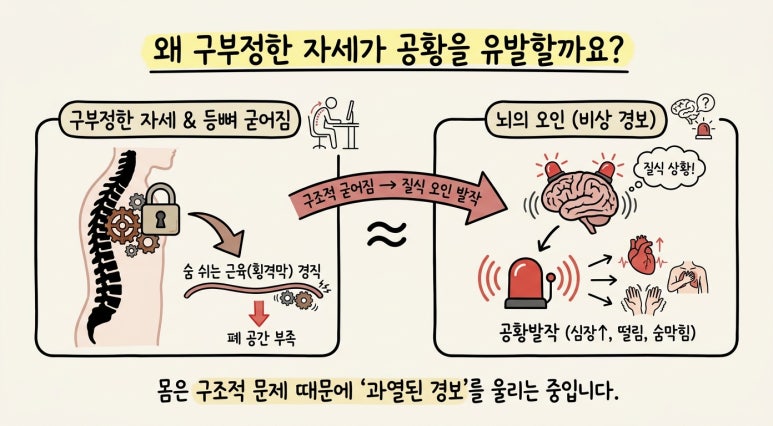 🧠 The Why | Root Cause Analysis
Why does slouched posture trigger panic?
When you work hunched in front of a computer, your spine stiffens, and the breathing muscle (diaphragm) attached below it becomes rigid.
This stiffened breathing muscle cannot descend sufficiently, leaving inadequate space for the lungs to expand.
Your brain misinterprets this state of insufficient airflow as a 'suffocation situation' and triggers an emergency alarm.
This emergency alarm leads to panic attacks—your heart racing, trembling limbs, and suffocating sensation.
Your body is sounding an 'overheated alarm' due to a structural problem.
Explanation | Korean Medicine Perspective
In Korean medicine, anxiety and panic are viewed as xin dan xu qie (心膽虛怯)—a state of weakened heart and courage—and as xin xu tan jie (心虛痰結), interpreted as pathology combining reduced heart function and accumulated waste (phlegm).
Modern Korean medicine adds structural problems of the spine and breathing muscles to this understanding, presenting clinical evidence that improving bodily structure can suppress the generation of phlegm that amplifies anxiety and restore heart-courage function.
📊 Proof | Case Examples and Evidence
Indeed, many office worker patients complain, "My heart tests normal, but it feels like a stone is sitting on my chest."
That stone is the stiffened breathing muscle (diaphragm).
A rigid breathing muscle is like a 'firmly closed dam' that cannot release water even when it rains.
Psychological anxiety only widens the cracks in this dam; the dam itself being rigid may be the root cause.
The breathing muscle must be loosened to open the dam.
🌊 Conceptual Metaphor: The Firmly Closed Dam, the Diaphragm
Indeed, many office worker patients complain, "My heart tests normal, but it feels like a stone is sitting on my chest." That stone is the stiffened breathing muscle (diaphragm).
A rigid breathing muscle is like a 'firmly closed dam' that cannot release water even when it rains. Psychological anxiety only widens the cracks in this dam; the dam itself being rigid may be the root cause. The breathing muscle must be loosened to open the dam.
 🔚 Closing | Summary and Encouragement
From now on, do not view panic disorder's breathing difficulty as merely a psychological issue.
Starting today, normalize your body's alarm system through paradoxical breathing correction and back-straightening routines.
Your body is stronger than you think.
It is simply sending the wrong signal for now.
You have the power to manage your anxiety.
Dongjedang Korean Medicine Clinic will be with you.
✍️ Reviewed by Director Choi Jang-hyuk, Dongjedang Korean Medicine Clinic
📚 References
[1] Korean Academy of Oriental Medical Psychiatry Clinical Practice Guideline for Panic Disorder (CPG, 2021)
[2] American Psychological Association (APA) Anxiety Guideline (2020)
[3] Diaphragmatic function and anxiety: a literature review. (Journal of Applied Physiology, 2022)
[4] The role of thoracic spine mobility in anxiety and breathing. (Physiotherapy Practice and Research, 2023)