
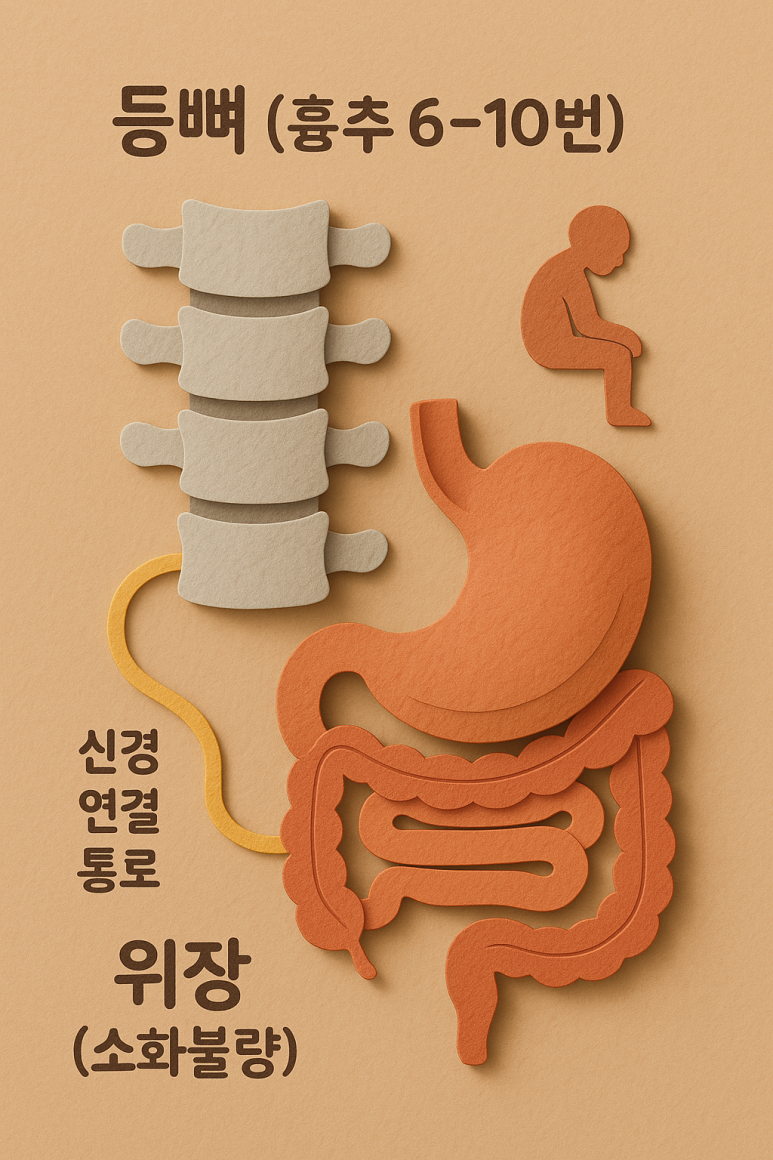
Straighten Your Back, Straighten Your Stomach: How to Stop Chronic Indigestion

 💡 Key Conclusion (Answer First)
Indigestion that doesn't improve even with medication—the culprit is your 'back.'
Do you keep hearing "it's nerve-related" no matter how many endoscopies you get, while always taking digestive aids?
Then it's time to look at your 'back (thoracic spine)' instead of your stomach.
The nerves that control the stomach originate from the thoracic spine (back bones), so when your back is hunched or misaligned, stomach function stops completely.
If you're experiencing chronic indigestion and back pain together, correcting the alignment of thoracic vertebrae 6 and 10 is the fundamental solution.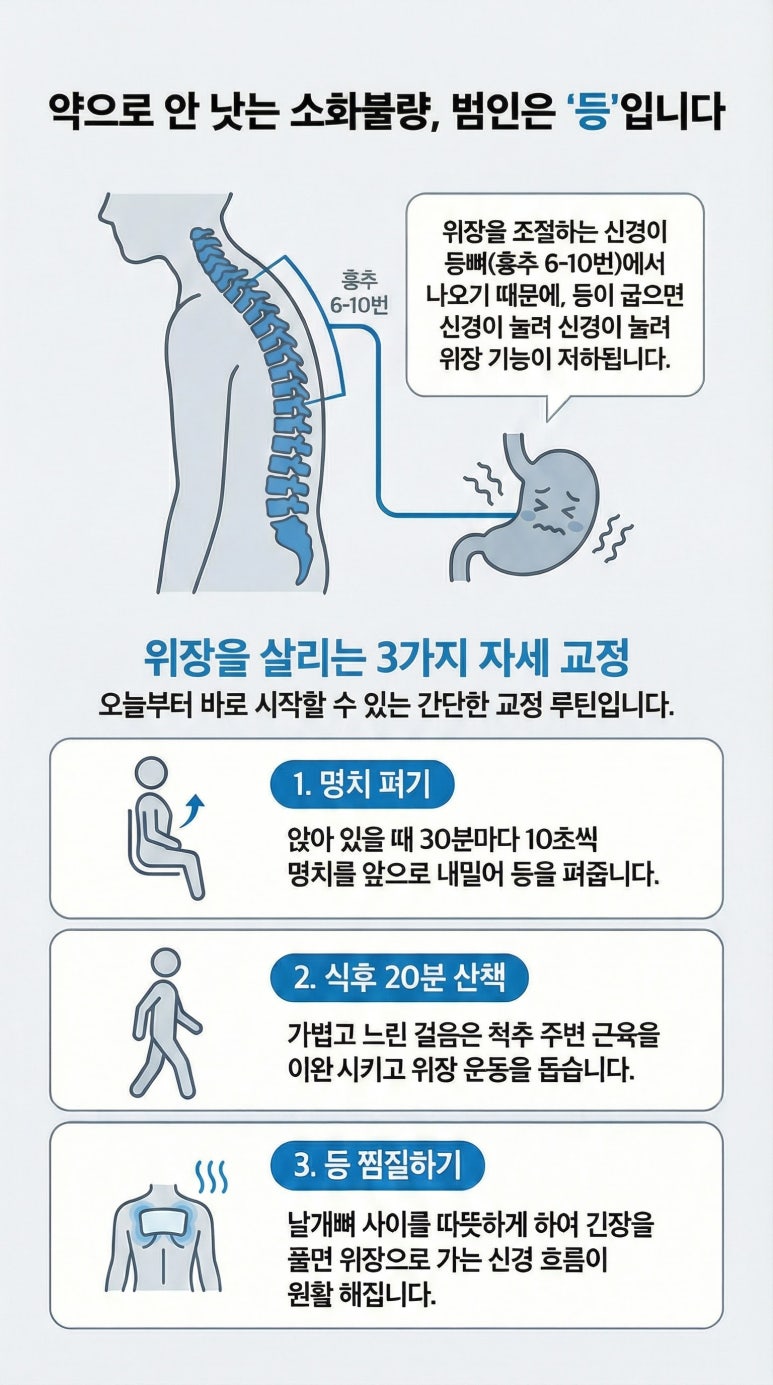
✅ Start Today: Top 3 Thoracic Spine Correction Routines to Save Your Stomach (Action)
Here are 3 habits you can start right now to simultaneously save your back and stomach.
| Routine | Specific Action Guidelines |
|---|---|
| Maintain 'Open Epigastrium' Posture | When eating or sitting, consciously push your epigastrium (the hollow area below your breastbone) forward and pull your shoulders back. Every 30 minutes while sitting, maintain an open epigastrium posture for 10 seconds. |
| 'Slow Walk' 20 Minutes After Meals | Don't sit or lie down immediately after eating. Light walking relaxes the muscles around the spine and the spine's movement helps the stomach's peristaltic movements. (However, it's important to walk slowly, not run.) |
| Warm Compress on the Back | You used to apply heat only to your stomach when digestion was poor, right? Now warm your back (between the shoulder blades and below them). When the tension in muscles around the thoracic spine is released, blood flow and nerve signals to the stomach become smooth. |
🚨 Seek Medical Attention Immediately If (Red Flags)
This is not simple indigestion.
If you experience the following symptoms, it may be referred pain from visceral disease beyond simple thoracic spine misalignment or serious spinal disease, requiring immediate medical attention.
Back pain doesn't disappear with rest and worsens at night (suspected tumor or infection).
Central back pain that feels like tearing accompanied by cold sweats or vomiting (suspected visceral diseases like pancreatitis, aortic dissection).
Along with indigestion, rapid weight loss or black stools (melena).
 📚 The 'Why': Why Does the Stomach Stop When the Spine Misaligns?
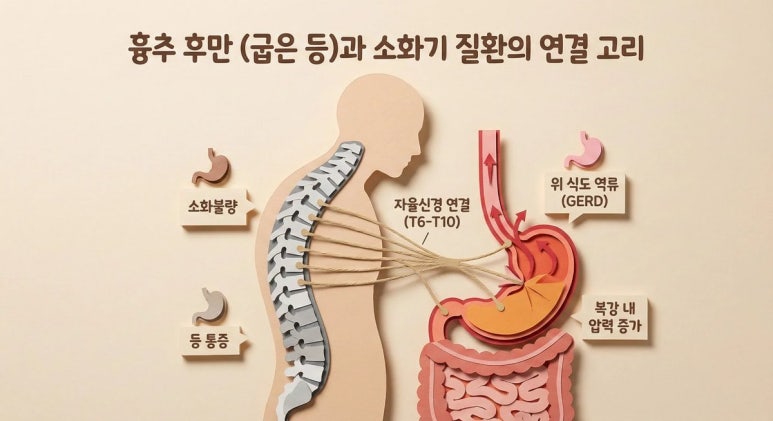
You can easily understand this by looking at your body's nerve structure. The 'stomach signal line' that moves the stomach and duodenum originates from the middle part of the thoracic spine.
- Signal Origin: The stomach signal line originates between thoracic vertebrae 6 and 10 in the middle part of the thoracic spine.
- Signal Interference: If this part of the thoracic spine becomes misaligned or the back muscles become stiff from poor posture or stress, this signal line becomes physically compressed.
- Stomach Failure: Just as water won't flow if a hose is kinked, the signal to the stomach weakens and the stomach stops working (gastric atony, indigestion).
In fact, when examining patients with severe esophagitis, the thoracic spine is often found to be hunched or laterally curved.
💡 Proof: When the Back Straightens, Digestion Opens
In clinical practice, when pressing the back of chronic indigestion patients, severe tenderness (pain upon pressure) or muscle tension is discovered in the thoracic vertebrae 6-10 area connected to the stomach. Actually, the folk remedy of "tapping the back when food gets stuck" works on the principle of releasing tension around the spine to improve stomach function.
This phenomenon aligns with the mechanism of reduced Vagus Nerve activity explained in modern functional medicine.
The Vagus Nerve is the most important neural superhighway connecting the brain and digestive system, controlling the stomach's peristaltic movements and gastric acid secretion.
The thoracic hyperkyphosis we commonly call 'hunched back' can stiffen muscles and tissues around the spine, causing indirect compression and inflammatory signals on this vagus nerve pathway.
Consequently, this reduces stomach motility, becoming a major functional cause of refractory dyspepsia.
Therefore, restoring proper spinal alignment is an important approach to addressing the functional root of digestive problems.
🧐 DEEP DIVE: Thoracic Spine and Stomach Autonomic Nerve Connection
The autonomic nervous system (parasympathetic nerve) that controls stomach movement originates between thoracic vertebrae 6 and 10.
When thoracic hyperkyphosis (hunching) or scoliosis (lateral curvature) occurs, the corresponding nerve becomes compressed, weakening the motor signals to the stomach.
✨ Closing: Straighten Your Spine to Restore Stomach Health.
If you still feel bloated even after taking digestive aids, check whether your back is hunched or your spine is misaligned.
Your stomach is connected to your back.
"Straighten your back, straighten your stomach."
We hope you overcome chronic indigestion through proper posture and spinal correction.
✍️ Reviewed by Director Choi Jang-hyuk, Dongjjedang Oriental Medicine Clinic
📚 Actual References
[1] Association Between Hunched Back (Thoracic Hyperkyphosis) and Gastrointestinal Disorders
Imagama, S., et al. (2014). "Influence of spinal sagittal alignment on gastroesophageal reflux disease in the community-dwelling elderly." European Spine Journal, 23(11), 2396-2401.
[2] Treatment Effect of Chuna Manual Therapy (Spinal Correction) on Functional Dyspepsia
Ko, S. J., et al. (2018). "Effect of Chuna Manual Therapy on Functional Dyspepsia: A Multicenter, Randomized, Controlled, Assessor-Blinded Pilot Study." Evidence-Based Complementary and Alternative Medicine.
[3] Physiological Mechanisms of Spinal Nerves and Visceral Function (Functional Medicine Evidence)
Pickar, J. G. (2002). "Neurophysiological effects of spinal manipulation." The Spine Journal, 2(5), 357-371.
[4] Vagus Nerve and Gut-Brain Axis
Bonaz, B., Bazin, T., & Pellissier, S. (2018). "The Vagus Nerve at the Interface of the Microbiota-Gut-Brain Axis." Frontiers in Neuroscience, 12, 49.
[5] Anatomical Evidence (T6-T10)
Netter, F. H. (2019). "Atlas of Human Anatomy" (7th ed.). Elsevier.